
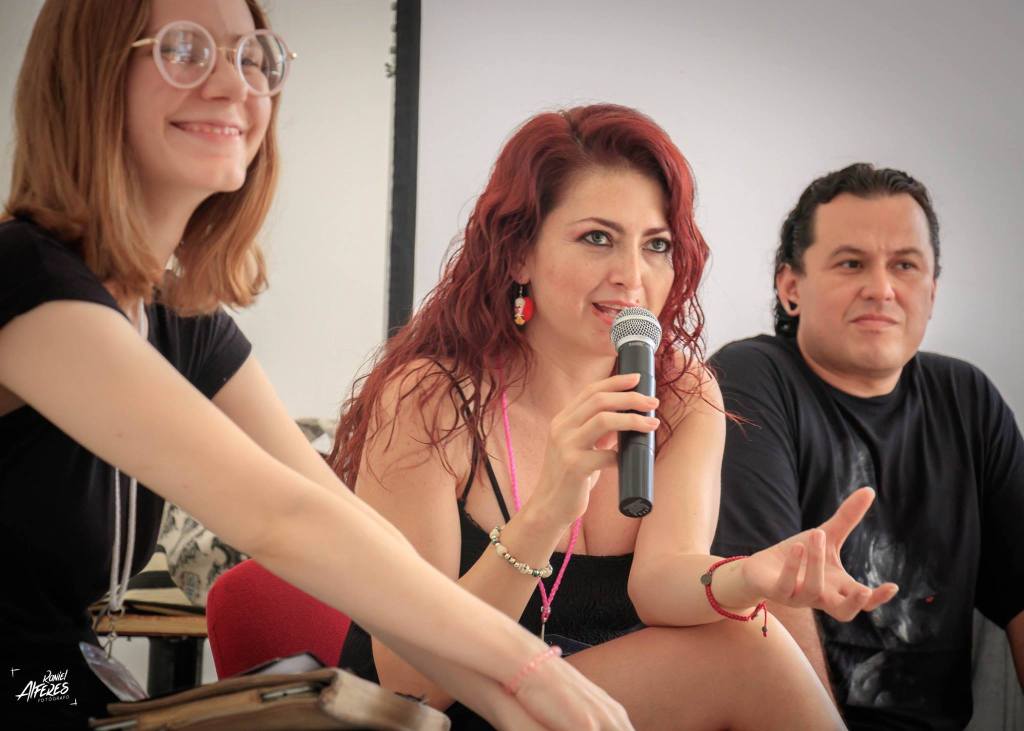
With a career spanning nearly three decades, Sandra Becerril stands as one of the most prolific voices in Mexican horror. As a novelist, screenwriter, and director, her passion for fear has led her to break new ground—becoming the first woman to direct a commercial horror feature in Mexico, and the first Mexican to work alongside legendary Hollywood horror masters. In this intimate conversation, Sandra shares the journey behind her chilling stories, how horror shaped her life, and why she continues to be a trailblazer for new generations of writers and filmmakers.
1.Could you tell us about your career in the horror film industry and what has kept your passion alive for 27 years?
I always wanted to be a writer. Screenwriters and storytellers were my superheroes. And my parents rewarded me with books on the weekends. Literature and horror became a reward.
I started writing stories for fantasy magazines (since there was no magazine specializing in horror in Mexico) at the age of 15. Shortly after, I studied a specialization in “Fantastic Literature and Science Fiction” and Screenwriting, so I began writing novels and adapting them to scripts. The novels were first published by small publishers until they reached Random House and Alfaguara.
My first novel was published when I was 19 years old “The Street of Witches”.
The first script of my authorship that was filmed was in 1999, an animated short film. From there, Juan Carlos Rulfo was the first to commission me to write a horror documentary script that Guillermo Arriaga produced, it was titled “Sera por eso.” I decided to direct soon after and made the first found footage feature film in Mexico, “El Escondite” (2004) and the first commercial horror feature film directed by a woman, “Están Aquí” (2009).
I think that among my achievements of which I am most proud is being the first Mexican (male or female) to work with the legendary masters of horror in Hollywood, creators of the great successes of the 80s, being the only Latina to have scripts written in the legendary series Masters Of Horror (Japan Version) or having adapted a series by Stephen King who has also read some of my novels and seen my films.
I have not stopped writing novels and scripts for 27 years and each year approximately two of my novels are published and between two and three scripts of my feature films are filmed.
What keeps my passion alive? I love scaring the public. When someone says that one of my stories gave them nightmares it is the best feeling in the world. In addition, horror has saved my life, it has taken me by the hand with the stories I have created to countries I never thought I would know. I love the horror genre, opening the way for new generations of writers and filmmakers is a great pride for me.
2. How does your experience as a horror novelist influence your approach to scriptwriting?
It has greatly broadened my perspective regarding the creation of atmospheres, the importance of the psychology of the characters, having discipline and not leaving stories halfway. Scriptwriting and novel writing complement each other, one is more visual, the other more introspective and the combination is wonderful.
3. Is there any particular film or project in your career that you think best encapsulates your vision as a horror film creator?
“Desde tu infierno” (From your hell). It was an adaptation I made of one of my novels. It encapsulates the vision I have because I was able to get involved in the production and help make the location I based the novel on (a Porfirian mansion owned by film director Oscar Blancarte in Colonia Roma in Mexico City) the same for the film. And the child I based the story on was my son, who also starred in the film. The feature film is more psychological, innocence plays a role in it, which turns out to be the cruelest thing there is. I love psychological stuff, although I also have some gore films like “Mashit,” which are very funny. I think horror should be funny too.
This film also led me to be nominated for the Ariel Awards for Best Adapted Screenplay. In 30 years, no woman had been nominated in this category, nor for any horror film.
4. Can you share your thoughts on how the horror genre has evolved throughout your career?
Every time there are new trends, it changes. Now, classics of cinema and literature that were freed from copyright are being taken up again and the story is twisted. It seems to me that before, more importance was given to the script, to the quality, to the public identifying with the characters. That’s why we miss certain movies from years ago.
Technology changed the way we see the world, so horror had to adapt as well.
But the foundation is the same: to provoke fear. A universal feeling that will not change and that everyone understands because everyone has felt it at some point.
5. What is your favorite part of the filmmaking process and how do you approach the balance between the creative challenges?
Ultimately the creation of the story. Watching the characters form, their conflicts, excites me. Once the actors bring them to life, it is something magical that will never cease to amaze me.
Balance for me is about letting go: In the case of a film, the script is no longer yours, once it is in the hands of the director and the crew, it is already a work of everyone in which each one imprints their own vision, which is usually not exactly the same as the creator’s. That is why you must let go, not cling.
The same happens with novels, once your editor has it, you must trust him. And then it is up to the readers and their interpretation. Letting go is the perfect balance to continue creating.
6. Could you tell us more about the script presented in Sinister and how it fits into your work in general?
The script I presented was “El Silencio.” (The silence) It is a story that I am very fond of because it is an adaptation of my novel “El silencio de todos los muertos,” (The silence of all dead) which was awarded in the literary contest “Se busca escritor” organized by Editorial De Otro Tipo (Mexico) where they were not looking for a horror novel and participated with other great ones from other genres. Usually, horror has no place in this type of contest.
It is a personal story where I tell part of my childhood and how my love for horror began by living in a haunted house in Mexico City and how the fact that you believe in supernatural things influences your childhood.
The rights to the novel have just been acquired by the most important production house in Mexico, so this script will soon be produced.
7. What advice would you give to aspiring horror filmmakers and novelists looking to make their mark in the industry?
To find their voice, to write about the genre they like, study it, watch a lot of movies, read, find their style, and something to say. Also to believe in themselves, that is the hardest thing of all in an industry where most people don’t believe in you.
Thank you so much for the questions! They were very interesting, and I really enjoyed answering them. They just made this New Year extra special. Thanks to Sinister for opening doors to creators. I really appreciate it.
You can follow my work on my IMDB page, I also post all the updates of book signings, premieres, events, festivals, workshops, etc. on my social networks:
Facebook: www.facebook.com/sandrabecerrilescritora
Instagram: escritora_serial
Twitter: @sandrabecerrilr


Leave a Reply