

In Hair Wraith, personal trauma merges with supernatural terror in a haunting narrative rooted in memory, mythology, and the enduring weight of abuse. Drawing inspiration from Victorian mourning rituals and a childhood nightmare, the film’s director crafts a visually bold and emotionally charged horror short that has captivated audiences across the globe. In this interview for Sinister Magazine, the filmmaker opens up about the roots of the story, the challenges behind production, and the powerful role of catharsis in horror storytelling.
1. What inspired the story of Hair Wraith, and how did the concept evolve during its development?
When I was four, my mother came home with a bizarre wreath woven from twisted vines that curled inward. Scattered among the tendrils were tiny red plastic apples. Two of the apples were placed in a way that made the wreath appear to have sinister red eyes. My mom had the bright idea of hanging the mutant wreath on the wall across from my bed. Night after night, I drifted into a recurring nightmare where the wreath would come to life. Its tiny plastic red apple eyes ignited into cruel glowing red eyes. The twisted vines sprouted arms and legs, and from its warped form, sharp gleaming teeth emerged. In my dreams, it would leap off the wall and chase after me, snapping its teeth at my feet. These dreams went on for months until, eventually, the wreath was put away for good.
While reading about the Victorian custom of memorializing the deceased by creating wreaths from their hair, I was reminded of the sinister wreath from my childhood. I was searching for a new concept for a script and wanted to write a story that was both entertaining and scary. The combination of this Victorian custom and my childhood memories of the wreath sparked the idea for Hair Wraith.
When writing Hair Wraith, the plot unfolded naturally. As the script evolved, so did the characters. Particularly when I cast the actress for Sally in the middle of the writing process. As I rewrote the script, I found myself incorporating elements of her personality, phrases she used, little quirks, and the way she carried herself. Initially, the character of Emma was mean, entitled, and bossy. When reading the script, I asked myself, who cares if this character dies? This pushed me to write Emma as a more innocent, kind, and caring person. Candice, the mother, originally lacked a backstory to explain her treatment of Sally. I had to find subtle ways to reveal why Candice behaved the way she did to make her character feel more grounded and believable.
2. Are there specific experiences or events that shaped the themes and meanings explored in the film?
Hair Wraith is shaped by personal experiences, though some aspects have been dramatized for the sake of the story. As I developed the plot, I wanted to center on the theme of overcoming something more powerful than oneself. The core of this theme was the impact of abuse. I sought to explore how abuse lingers long after the physical scars have healed, and how the memories and pain resurface even after the abuser is gone from an individual’s life. Hair Wraith is a deep-seated examination of abuse and its far-reaching effects of psychological trauma and oppression. I wanted to use Hair Wraith to celebrate the ritual of catharsis and its ability to vanish and conquer the demons of our memory.
3. What were the major influences—films, personal experiences, or artistic movements—that guided the direction of Hair Wraith?
There was a slew of films that guided the direction of Hair Wraith. In terms of camera visuals and special effects, Hair Wraith pays tribute to horror films such as Halloween, A Nightmare on Elm Street, Evil Dead II, Suspiria, Jacob’s Ladder, and Child’s Play. No CGI effects are used in Hair Wraith. Effects are in-camera or practical. When guiding performances, I drew inspiration from Bruce Campbell’s work in Evil Dead II, Neve Campbell’s in Scream, and Isabelle Adjani’s in Possession. For one scene in Hair Wraith, I was inspired by the scene in Fright Night (1985), when Peter Vincent (Roddy McDowall) watches Evil Ed (Stephen Geoffreys) transform from a wolf back into a teenage boy. This scene is one of my favorites in horror, as it balances emotional depth with incredible practical effects. I used this as a reference for myself as a director to help shape a key moment in Hair Wraith. In terms of story and themes, Hair Wraith draws from The Exorcist and the modern works of Jennifer Kent and Mike Flanagan.

4. Could you elaborate on the production process? Were there any memorable moments or challenges that stood out?
Like any film, Hair Wraith faced its fair share of challenges—losing key crew members just days before the shoot, losing the main location, dealing with unhinged neighbors, plant damage, and various logistical issues. While I have plenty of stories about the obstacles we overcame, I’ll focus on the positive. One of the most memorable moments came while filming one of my favorite scenes in the entire film. I can’t say the specific scene without spoiling the plot, but I remember looking up from the monitor for a moment and seeing nearly the entire crew gathered around it, fully engaged in what was unfolding on screen. Some had sly grins, while others were in awe. It was a thrilling moment, as it made me realize we had something truly special—and that the actresses’ incredible talent would carry the film, even if everything else went wrong.
5. How did you approach the visual and sound design to enhance the film’s eerie and atmospheric tone?
For the visual design of Hair Wraith, I immersed myself in dozens of horror films spanning various decades. Over time, the visual style started to flow naturally as these influences settled into my subconscious. Many horror films use camera movement to build suspense or follow the action. My director of photography and our camera operator crafted shots where the camera primarily moved during or just before paranormal events. We also used movement to reveal terrifying moments. For the shot composition, I drew inspiration from Halloween, opting for wide shots to evoke a sense of loneliness and isolation, which I believe can heighten suspense.
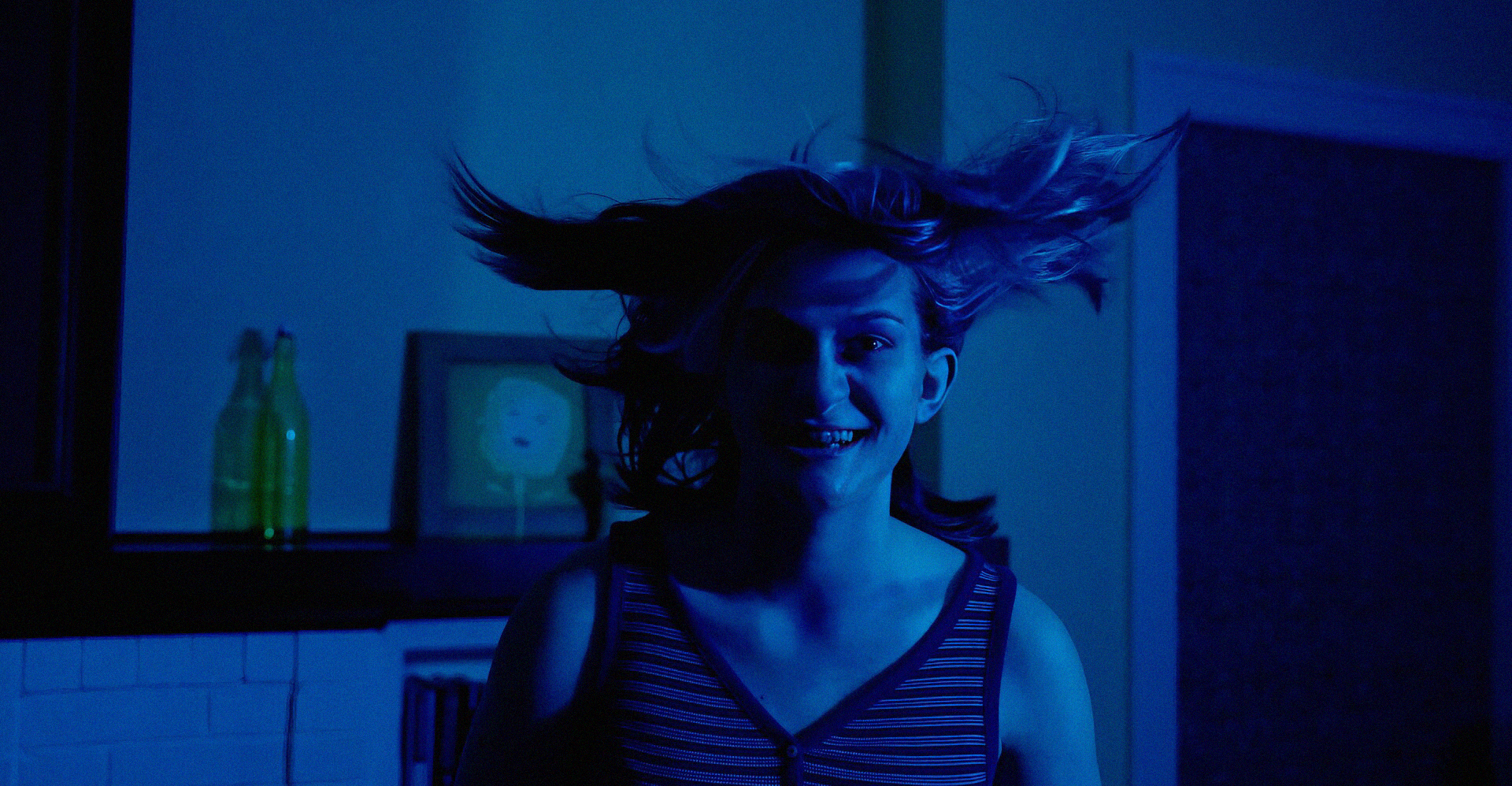
I believe horror is a genre that can allow for theatrical approaches. Coming from a theater background, that’s exactly what I wanted to bring to the film in terms of lighting and color. I wanted to use bold, non-naturalistic colors to create visual variety. I was deeply inspired by Suspiria and A Nightmare on Elm Street. For the moonlight sequences, the specific shade of blue was inspired by A Nightmare on Elm Street and similar films. In Hair Wraith, there is a scene where Sally discovers a witchcraft book in her mother’s bedroom. For that scene, I chose a purple hue for the lighting, drawing inspiration from Suspiria. The same approach applies to the final scene, which features a green hue. I was also fortunate to have a talented lighting team that expertly crafted an eerie atmosphere, helping to bring the world of Hair Wraith to life.
At my first meeting with the composer, I told him I wanted intense, uncomfortable banging sounds during heightened moments. He agreed with the direction and played a track from Spider-Man: Into the Spider-Verse. I hadn’t seen the film yet and was a bit skeptical, but as soon as he played the music, I knew that was the right path for the score.
For sound design, my editor was instrumental in shaping where to place sound and which elements to emphasize. We both agreed that the sound needed to be powerful to heighten the horror. I gave my sound designers a simple directive: big but quiet. We worked closely on the paranormal scenes, developing sounds like whispering voices, quiet female laughs, and other eerie effects. During one scene, the sound cut out due to an actress’s loud scream, but the sound designers quickly found a solution. When my editor and I watched the film with the final sound design, we both jumped out of our seats. The sound team had seamlessly hidden the mic cut with a sound that would have an incredible impact on the audience.

6. What kind of response has Hair Wraith received from audiences, and did anything surprise you about their interpretations?
When Hair Wraith first screened, I was surprised by how well the audience responded to the dramatic aspects of the story. I was worried the drama might overshadow the more entertaining elements of the film, but for most viewers, it enhanced the horror sequences. I was also uncertain about how the audience would react to the practical effects, given how accustomed people are to CGI these days. However, the practical effects were among the most talked-about elements, along with the actresses’ performances. To date, Hair Wraith has placed in and/or won 23 USA and international film festivals.
7. What’s next for you? Are you working on new projects or expanding on the themes explored in Hair Wraith?
I currently work as an editor for Questar Entertainment, a film distribution company in Chicago. I’m also editing a docuseries for Reggie’s, a music venue in the city. Through my work at Reggie’s, I’ve connected with a new collaborator who owns a motorcycle and is interested in creating genre shorts featuring it. They’ve asked me to write and direct a horror short featuring their motorcycle. I’ve been inspired by “The Legend of the Elmore Rider” (a local tale in the State of Ohio, USA involving a headless motorcycle rider) and am adapting this legend into a found-footage horror film. I’m also developing a feature-length script for Hair Wraith.


Leave a Reply