
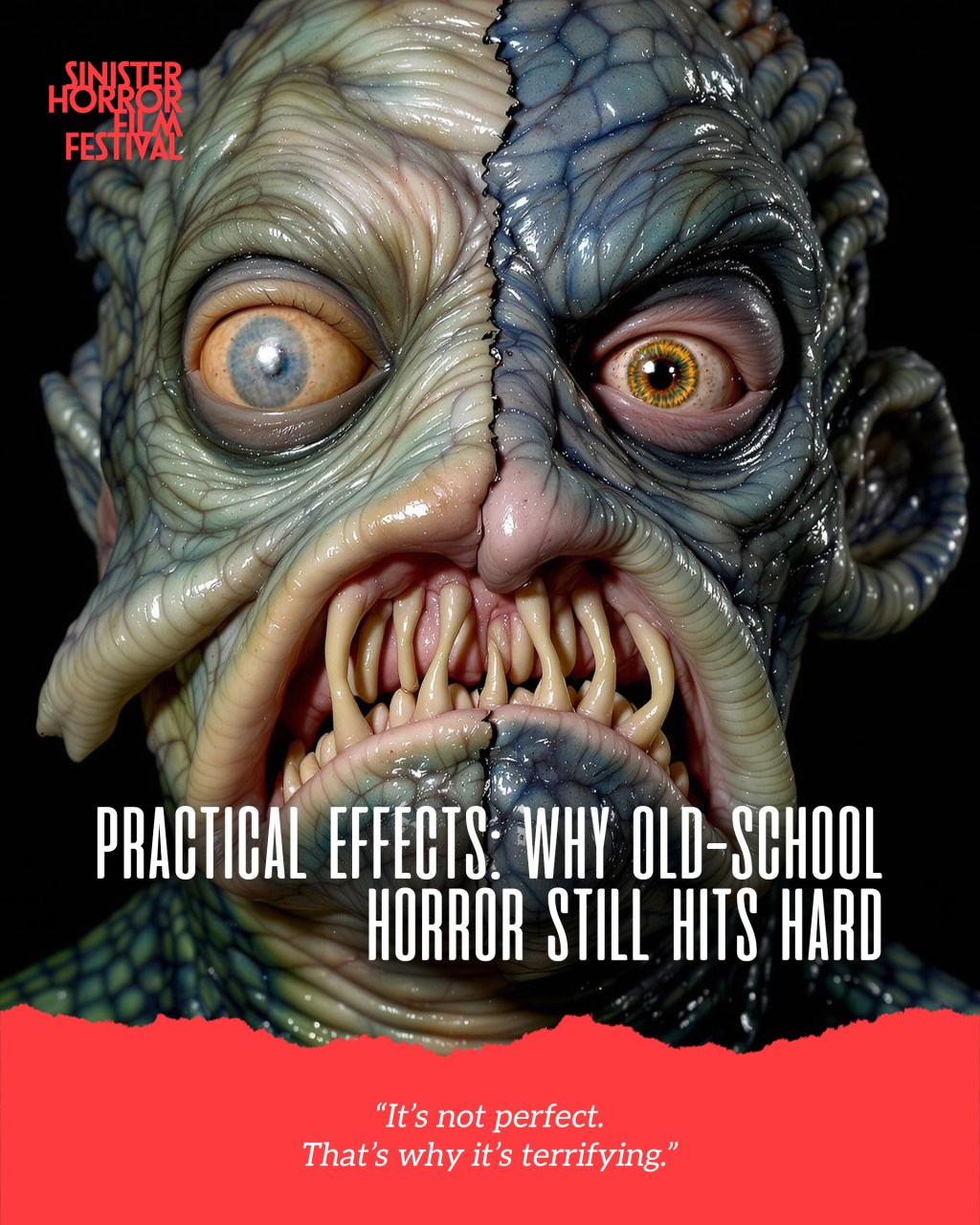
When Gore Feels Real, the Terror Stays With You
In an era dominated by CGI spectacle and digital wizardry, one question lingers in the minds of horror purists: Why do practical effects still haunt us in ways that CGI rarely can?
Sure, CGI can conjure unimaginable horrors—a swarm of digital insects, a monstrous apparition, a creature with too many eyes and too many teeth. But practical effects? They’re tangible. They exist in physical space, under real lights, casting real shadows. They bleed, they ooze, they break apart in ways that feel disturbingly authentic. And that authenticity is what makes them so unforgettable.
The Tangibility of Terror
Practical effects, whether it’s gallons of fake blood, latex skin, or animatronic limbs, create a sense of physical presencethat digital creations struggle to replicate. You can sense the weight of a severed head, the texture of rotting flesh, the grotesque squish of entrails spilling onto the floor.
In John Carpenter’s The Thing (1982), Rob Bottin’s practical FX work is nothing short of legendary. From the spider-legged head to the contorted, melting faces, every grotesque transformation feels repulsively real. There’s a visceral, gut-wrenching quality to the carnage that digital blood simply can’t achieve. The blood and guts are there, splattering against the actors, staining the floors, writhing in ways that feel disturbingly organic.
Then there’s Evil Dead (1981), where Sam Raimi unleashed a torrent of practical gore that still shocks audiences decades later. From decapitated bodies spewing blood to claymation corpses rotting in real-time, the physicality of the effects grounds the horror in a tangible, in-your-face reality. You can almost smell the decay, feel the sticky blood, hear the crunch of splintering bones. CGI might render these things with pristine clarity, but it can’t replicate that tactile grittiness.
Why Practical Effects Stick With Us
Why do practical effects linger in our minds while CGI scares often fade away?
The answer lies in the way we process reality. When something physically exists on set, under the same lighting as the actors, our brains subconsciously register it as more credible. We can sense its weight, its texture, its imperfections.
CGI, no matter how advanced, often struggles to replicate the randomness of reality—the way blood flows, the way flesh tears, the way shadows cling to uneven surfaces. In films like Hellraiser (1987), Clive Barker used practical effects to create Cenobites whose flesh is grotesquely stretched and torn in ways that feel disturbingly anatomical. The slick, wet sinews glisten under harsh light, making the horror viscerally tactile.
Contrast that with digital gore, which can sometimes look too clean, too smooth, too precise. CGI tends to lack the grit and grime that practical effects deliver so effectively. And in horror, it’s that grit—the dirt under the fingernails, the blood splatter on the walls—that makes the fear feel real.

The Evolution of Practical FX in Modern Horror
While CGI has undeniably revolutionized visual storytelling, practical effects are far from extinct. In fact, many contemporary horror filmmakers are returning to old-school techniques to evoke a more visceral response from audiences.
Ari Aster employed practical effects extensively in Hereditary (2018), from decapitated heads to charred corpses. The gruesome realism of these effects heightens the horror, grounding it in a physical world that feels oppressively close.
Similarly, Robert Eggers used practical FX in The Witch (2015) to conjure the unsettling period atmosphere, from the blood-soaked barn to the chilling imagery of Black Phillip. The dirt, the grime, the blood—they’re all there, on screen, undeniably present.
And let’s not forget The Exorcist: Believer (2023), which brought back practical prosthetics and makeup effects to capture the raw, unsettling look of demonic possession. The result? A haunting, physical transformation that feels disturbingly real in ways that digital effects often miss.
When Practical Effects Go Too Far
Of course, practical effects have their own pitfalls. They can be cumbersome, messy, expensive, and time-consuming. When not executed properly, they can look laughably fake—think rubber masks, obvious puppets, and visibly staged blood sprays. But when they’re done right, they can be traumatizingly effective.
Take Society (1989), where Screaming Mad George’s nightmarish practical FX work in the infamous “shunting” scene remains one of the most grotesque and unforgettable moments in body horror history. The flesh melds, twists, and stretches in ways that CGI could never replicate. It’s a nauseating, skin-crawling spectacle that sticks with you, whether you want it to or not.
What practical FX moment still makes your skin crawl?


Leave a Reply